A video game romance affecting the physical world should, by design, be an impossibility. The player selects a partner from a curated roster, follows a prescribed sequence of approval-gaining interactions, and eventually triggers a scripted intimacy scene. For the most part, every step is predetermined by developers. At least for now, there is no real spontaneity, genuine reciprocity, or risk of rejection; as every predetermined path will have a set outcome of some kind.
Yet the emotional investment players report in these fictional relationships consistently exceeds the attachment audiences develop toward romantic storylines in film or television (media whereby the same story unfolds identically for every viewer). Thus, the question worth delving into is not whether this attachment is real (research increasingly confirms it is) but why the illusion of choosing a partner generates deeper emotional bonds than merely observing one?
The Mechanics of Manufactured Intimacy
The answer lies in a psychological mechanism media researchers have studied for decades: the parasocial relationship. First described by Horton and Wohl in 1956, parasocial relationships are one-sided emotional bonds audiences form with media figures – whether real celebrities or fictional characters – through the perception of face-to-face interaction. It may be argued how television pioneered this dynamic whereas video games have started to, lamentably, weaponise it.
A 2016 study by Song and Fox, examining female players of romantic video games (RVGs) in China, found avatar identification and parasocial attachment mediated the relationship between game exposure and romantic beliefs. The more players identified with their in-game avatar, the stronger the emotional bond they formed with the characters they romanced. What makes this finding particularly striking is the mechanism at work: it was not the quality of writing or visual fidelity driving attachment, but the player’s sense of agency. In other words, is the feeling of having chosen and shaped the relationship.
This notion was pushed further by Gong and Huang’s 2023 study, published in Computers in Human Behavior, which examines the link between social anxiety and romantic parasocial interaction among female otome game players. Their research found socially anxious players were more inclined to form romantic parasocial bonds with game characters. Crucially, these bonds positively influenced continued playing intention and in-game purchase behaviour. The implication here is somewhat uncomfortable: the same design features generating emotional attachment are, in some contexts, also generating revenue. Keep this in mind.
A qualitative study published in Media and Communication through Cogitatio Press examined the phenomenon from the player’s perspective, finding female otome game players showed a high degree of acceptance and immersion in their parasocial romantic relationships, often focusing on the emotional support provided by male characters. These relationships played a positive role in fulfilling emotional needs and regulating negative emotion. However, the researchers also identified a crucial limitation: the intimacy was only partial. Although emotional closeness was achievable, physical closeness was not. As such, when players started recognising the commodified nature of their romantic interests (through in-game purchasing mechanics), the perception of a purely emotional relationship began to fracture.
Adding a further layer to the discussion is Tukachinsky’s framework, established in 2010, which distinguishes between parasocial romance and parasocial friendship. In traditional media, audiences typically form one type or the other. With that said, video game romance mechanics – particularly those requiring the player to travel with, fight alongside, and confide in a companion before any romantic arc begins – have been shown to activate both simultaneously. The player is often friend and lover to the same character, commonly through similar interactions. This dual activation may explain why the emotional residue of a video game romance lingers longer than a film crush: there are simply more psychological threads to sever when the experience ultimately ends.
A Formula Unchanged Since the early 00s
Few studios illustrate this video game romance dynamic more clearly than BioWare – a developer whose name has become practically synonymous with companion romance in Western Role-Playing Games (RPGs). From Star Wars: Knights of the Old Republic (2003) through to Dragon Age: The Veilguard (2024), BioWare’s romance template has followed a remarkably consistent structure: speak to the companion at the party’s base of operations; validate their backstory or help them overcome a personal trauma through dialogue unlocked after each main mission; select the romantic dialogue option when it presents itself (sometimes helpfully marked with a heart icon); and eventually culminating with a shared a night together before the final battle. As Sarah Stang observed in Game Studies (2019), these relationships develop in predictable, isolated pockets, and are largely disconnected from the consequences of the main narrative.
The structural irony of the way these relationships develop is difficult to overstate and important to take note of, however, because research shows how this formulaic and predictable romance system in gaming produces some of the most intense reported player attachment. Characters like Bastila Shan from Star Wars Knights of the Old Republic, Alistair from Dragon Age: Origins, and Liara T’Soni from Mass Effect (whose relationship persists across three main-line games) are often discussed by fans with an emotional specificity typically reserved for real relationships. The BioWare formula works precisely because its predictability eliminates risk. The player knows, on some level, affection will be reciprocated if they say the right things, which is a guarantee no real relationship can offer. In this sense, the parasocial bond is not merely formed through interactivity; it is formed through the certainty of positive outcome, a dynamic the safety of scripted video game romance provides by default.
When Video Game Romance Learned Consequences
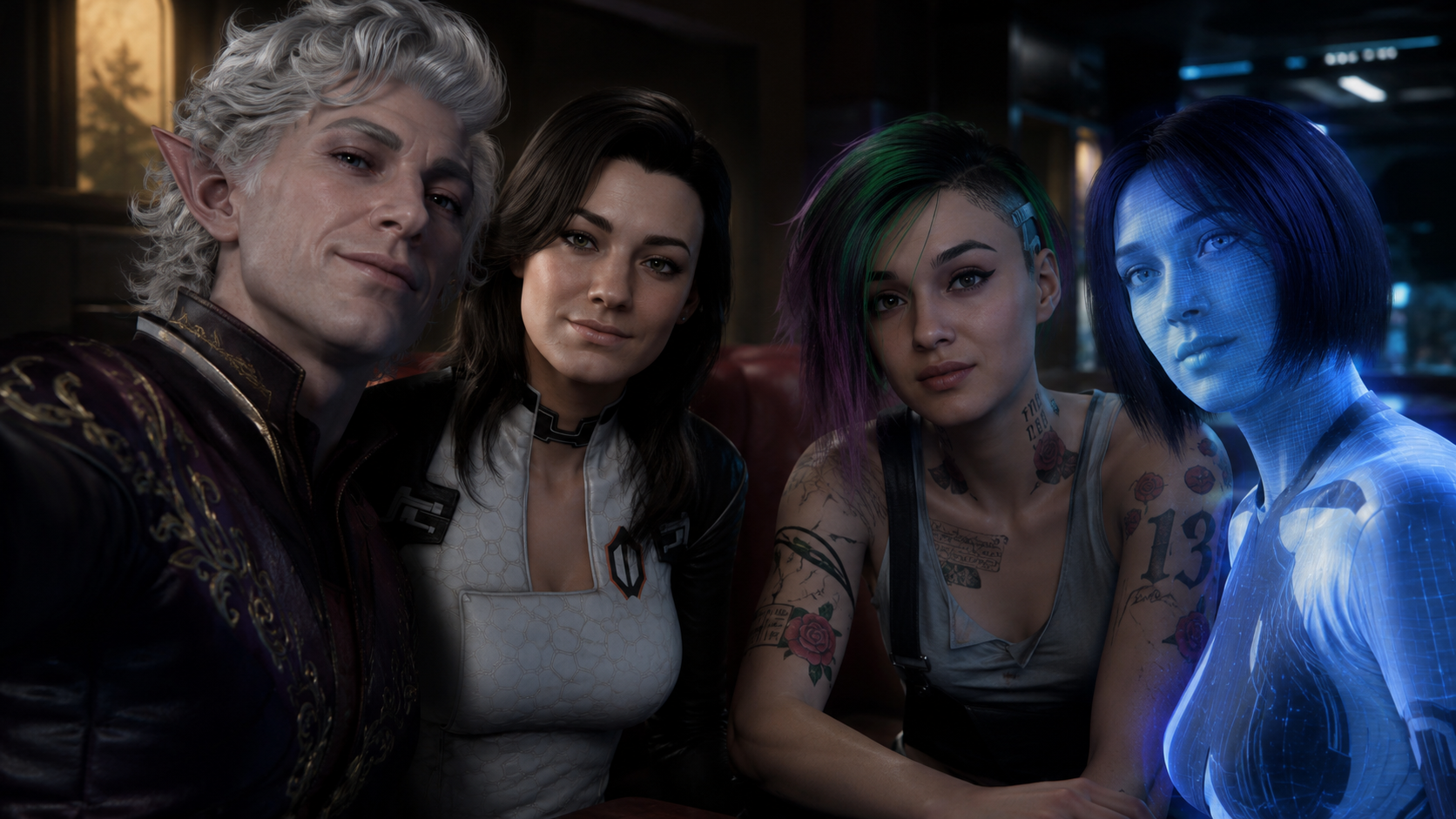
Baldur’s Gate 3, developed by Larian Studios and released in 2023, complicated this calculus. Whilst BioWare’s model rewarded persistence with guaranteed reciprocation, Larian’s approach introduced something closer to emotional risk. Romancing Astarion – the game’s sardonic vampire spawn who rapidly became its breakout character – carries genuine narrative stakes: pursuing his “ascension” can permanently end the relationship if the player chooses a path the character finds morally repugnant. Then there is Shadowheart’s romance arc, involving trade-offs between her personal identity and her faith, demanding the player engage with moral ambiguity rather than simply affirming their chosen partner.
These additional layers of complexity and resultant changes to the video game romance relationship formula have resulted in an unprecedented depth of player investment. Astarion alone has generated over 20,000 works of fan fiction on Archive of Our Own; with fan art, video essays, and community discourse around the game’s romantic storylines persisting long after launch. Larian’s writer Kevin VanOrd noted the studio had even grander ambitions for the system, including a platonic friendship track for companions the player chose not to romance. Alas, it was eventually cut due to time constraints.
What Baldur’s Gate 3 revealed is a refinement of the parasocial mechanism identified in the research. Players do not simply want safety; they want the illusion of risk contained within a safe structure. The relationship must feel breakable to feel earned, even if the “breaking” is a scripted outcome. This is parasocial attachment operating at its most sophisticated: players experiencing genuine anxiety about a relationship whose parameters were defined in a developer’s script, now feel relief when it survives a narrative crisis the writers always intended it to survive. The felt emotion is very real, yet the reciprocity generating it is obviously not.
The Convenient Dismissal
It would be intellectually dishonest to present this video game romance argument without stress-testing its foundations. The research base on parasocial attachment in video games remains relatively young, and the most rigorous studies – Song and Fox, Gong and Huang, the Cogitatio Press qualitative work – focus overwhelmingly on East Asian otome game audiences. Whether these findings generalise cleanly to Western RPG players navigating BioWare or Larian romance systems, among others, is an open question. What is clear, however, is how the distance between these cultural contexts, and the distance between their respective design philosophies, continues to diverge further still.
Lewis, Weber, and Bowman (2008) offered a more fundamental challenge with their character attachment metric, arguing the connection between a player and their avatar is tangible rather than parasocial – a rather important distinction for this discussion. If the player-character relationship is genuinely bidirectional in some phenomenological sense (the player controls the avatar; the avatar mediates the player’s experience of the game world), framing it as a one-sided parasocial bond may be misleading. The player is not merely observing a character from the outside, as a television viewer does; they are, for all intents and purposes, inhabiting the relationship from the proverbial inside.
Sample sizes across the existing studies are also modest. Gong and Huang surveyed 615 participants; and the Cogitatio Press research used in-depth interviews rather than broad surveys. Although these are clearly defensible methodological choices, they do constrain the confidence from which sweeping claims about “all gamers” can be made. Thus the mechanisms are theorised and directionally supported; but have yet to be proven at scale.
The Grief No One Designed For
Where the theoretical picture sharpens into something more tangible is in its intersection with post-game depression (a phenomenon covered previously). The 2026 Post-Game Depression Scale (P-GDS), developed by psychologists Kamil Janowicz and Piotr Klimczyk and published in Current Psychology, identified four dimensions of the experience: game-related rumination (intrusive thoughts about the plot); a challenging end of experience; compulsive need to replay; and media anhedonia (loss of interest in other entertainment). Their headline finding of how ‘RPG players are the most susceptible’ seems to align precisely with the parasocial attachment research.
Janowicz described the phenomenon as “a specific type of grief after loss, reminiscent of parting with a loved one”. This framing maps directly onto parasocial breakup theory from media psychology, which is a well-established framework describing the distress audiences feel when a television series ends and the parasocial relationships within it are permanently severed. It is quite clear how the parallel is present, however there is a crucial amplifier serving as a differentiator. When a television series concludes, the viewer mourns a relationship they watched. When a game ends, the player mourns a relationship they believe they built. The sense of agency, of having chosen and sustained these bonds, transforms the grief from observational to something far more personal.
An earlier qualitative study by Janowicz (2023), published in Cyberpsychology: Journal of Psychosocial Research on Cyberspace, captured this dynamic through player narratives. Participants who finished certain narrative heavy games described intense feelings of loss; with some reportedly resorting to browsing the internet compulsively for additional content about the game, all in an attempt to sustain a connection the credits had formally ended. The parallel to parasocial breakup behaviour in television audiences was unmistakable; yet clearly and consistently more intense.
The uncomfortable implication beneath all this research is a design ethics question the industry has largely declined to ask. If video game romance mechanics are engineered – whether consciously or through iterative refinement – to cultivate parasocial attachment, and if the resulting attachment produces measurable grief when the experience ends, would developers arguably carry some responsibility for the emotional aftermath? At first this concern may seem somewhat hypothetical. However, in the gacha-driven otome game market, the link between romantic parasocial interaction and in-game spending is already being deliberately monetised.
Love and Deepspace, one of the highest-grossing titles in the genre, designs its interaction systems (voice lines, phone-shaking Easter eggs, pseudo-physical touch responses) explicitly to simulate companionship, and the developers have spoken publicly about making male leads feel like “true companions”. The business model then layers premium story gates and limited-time events on top of those engineered bonds, converting emotional dependency into recurring revenue. The reality here is how this is not attachment as a byproduct of good storytelling, rather it is attachment as infrastructure for a spending funnel.
Whether the Western RPG tradition of companion romance carries the same ethical weight is a fair question, and the answer is not straightforward. BioWare and Larian sell a complete product; the video game romance is included in the purchase price, and no additional spending is required to sustain it. The emotional attachment their games generate is, in this framing, a mark of craft rather than exploitation. Yet the mechanism remains identical, and the grief it produces is indistinguishable. If developers are responsible when monetisation follows attachment, are they absolved when it does not?
VanOrd’s aforementioned proposed friendship system for Baldur’s Gate 3 (designed to give unromanced companions their own deepening arcs) hints at one possible answer: design for both the height of the bond and its resolution. Give players a way to transition out of the relationship rather than severing it at the credits. The counterargument, naturally, is how designing away grief also means designing away meaning. However, the loss is what proves the love was real, or at least allows it to feel that way.
Either way, the mechanism remains the same: the player chooses; the game responds; the bonds form; the credits roll; and the grief arrives. Video game romance, it seems, is the only kind of love where the beloved was never real… yet the loss, unmistakably, is.
Sources
- Burgess & Jones (2017). Character attachment and agency in the Mass Effect 3 ending controversy. Bulletin of Science, Technology & Society, 37, 146–158
- Cogitatio Press (2024). “Parasocial Interactions in Otome Games”
- GamesHub (2024). “Dragon Age: The Veilguard shows video game romances transcend playtime”
- Gong, A-D. & Huang, Y-T. (2023). “Finding love in online games: Social interaction, parasocial phenomenon, and in-game purchase intention of female game players”
- Janowicz, K. & Klimczyk, P. (2026). “Post-game depression scale – a new measure to capture players’ experiences after finishing video games”
- Janowicz, K. (2023). “What is the post-game depression? A narrative inquiry”
- Lewis, M.L., Weber, R., & Bowman, N.D. (2008). “They may be pixels, but they’re MY pixels: Developing a metric of character attachment in role-playing video games”
- Song, H. & Fox, J. (2016). “Playing for Love in a Romantic Video Game: Avatar Identification, Parasocial Relationships, and Chinese Women’s Romantic Beliefs”
- Stang, S. (2019). “‘This Action Will Have Consequences’: Interactivity and Player Agency”
- Tukachinsky, R. (2010). Parasocial Relationships Scale (distinguishing parasocial romance from parasocial friendship)
- VanOrd, K. (2025). Interview in Edge magazine on Baldur’s Gate 3 romance system ambitions

Owner, founder and editor-in-chief at Vamers, Hans has a vested interest in geek culture and the interactive entertainment industry. With a Masters degree in Communications and Ludology, he is well read and versed in matters relating to video games and communication media, among many other topics of interest.
- Hans Haupthttps://vamers.com/author/hanshaupt/

- Hans Haupthttps://vamers.com/author/hanshaupt/

- Hans Haupthttps://vamers.com/author/hanshaupt/

- Hans Haupthttps://vamers.com/author/hanshaupt/

- Hans Haupthttps://vamers.com/author/hanshaupt/

- Hans Haupthttps://vamers.com/author/hanshaupt/

- Hans Haupthttps://vamers.com/author/hanshaupt/

- Hans Haupthttps://vamers.com/author/hanshaupt/