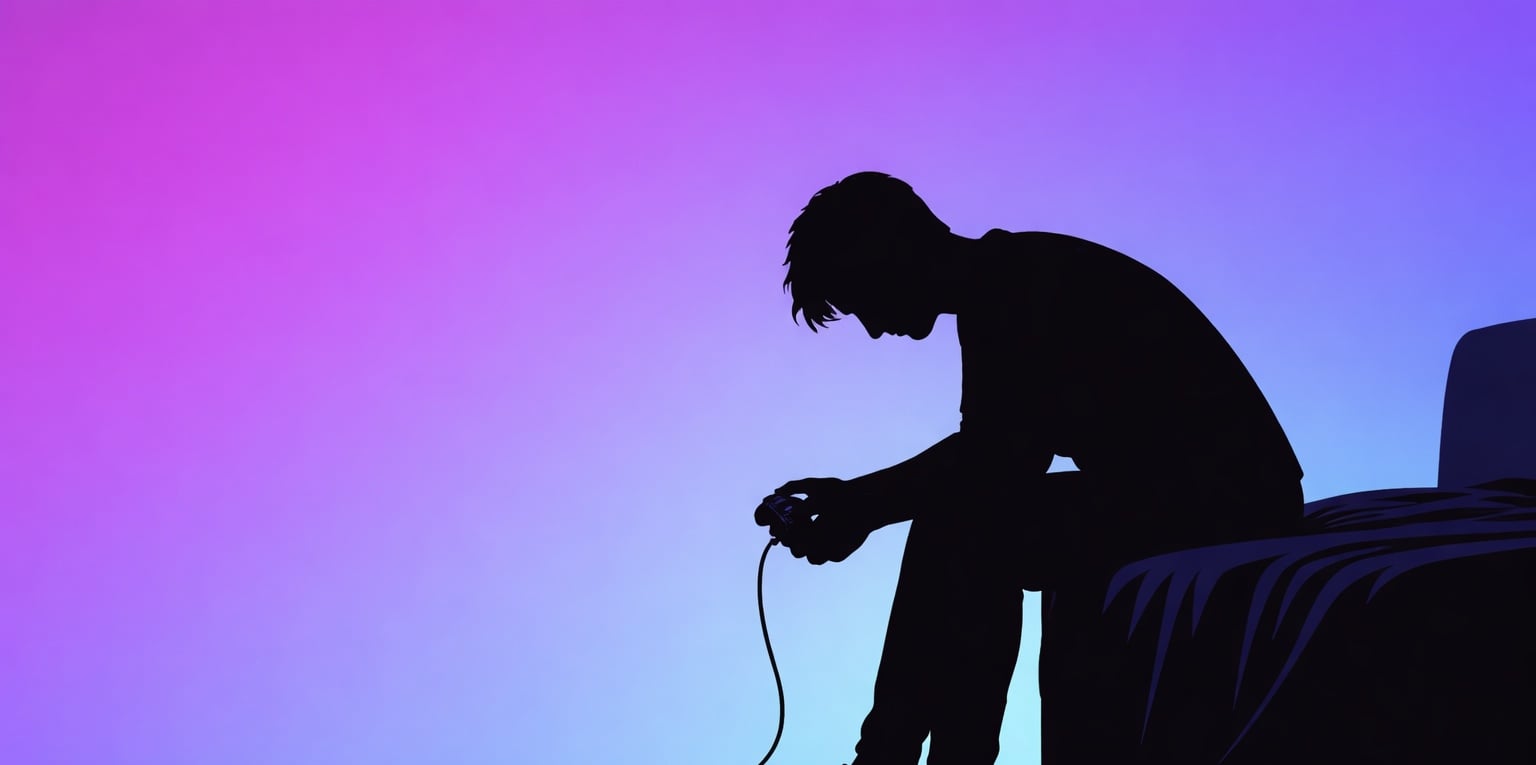
The final cutscene fades, the credits begin to scroll, and the moment the controller goes down (or hands lift from the mouse and keyboard), an irrevocable emptiness becomes apparent. Every gamer knows the feeling. It is not satisfaction, per se, nor is it relief; more so an unsettling void where a world used to be. For years, gaming communities have called this experience “post-game depression”, a term passed around Reddit threads and Discord servers with knowing nods, but little scientific backing. Now, researchers have finally given it the academic treatment it arguably deserves.
A study published in Current Psychology by psychologists Kamil Janowicz (SWPS University) and Piotr Klimczyk (Stefan Batory Academy of Applied Sciences) introduces the Post-Game Depression Scale (P-GDS): the first quantitative tool designed to measure the intensity of emotional distress players experience after completing a video game. The paper, which builds on Klimczyk’s earlier qualitative work from 2023 in Cyberpsychology: Journal of Psychosocial Research on Cyberspace, moves the conversation from anecdotal forum posts into measurable and peer-reviewed territory.
What the Research Actually Found
The study involved 373 players across two separate investigations. Participants were recruited through social media, Reddit, Discord, and mailing lists; and then tasked with completing surveys measuring their emotional responses after finishing games (alongside broader assessments of well-being and mental health). Most reported playing daily or almost daily, and the most common play style was solo gaming.
From the data, the researchers identified four distinct dimensions of post-game depression: game-related rumination (intrusive, recurring thoughts about the story); a challenging emotional end to the experience; a felt necessity to replay the game; and media anhedonia, meaning a reduced interest in other forms of entertainment. Of these, rumination emerged as the strongest factor whereas media anhedonia (in this sense the inability to find pleasure in other media after a powerful gaming experience) was the least intense, though still present.
Critically, the study also found a correlation between higher levels of post-game depression and stronger depressive symptoms alongside lower overall well-being. However, the researchers themselves are explicit about the fact they cannot determine the direction of this relationship – a point most coverage has glossed over. It remains unclear whether finishing a game causes depressive feelings, or whether individuals already prone to depression simply experience more intense emotional responses when a game ends. The study is cross-sectional, not longitudinal, which means it captures a snapshot rather than tracking cause and effect over time. Despite being a good starting point, additional research is obviously needed on this topic in order to provide further clarification and understanding.
Grief, Not Diagnosis
One of the more nuanced findings is how the researchers frame post-game depression. Rather than positioning it as a clinical condition, Janowicz describes it as a form of grief – a response comparable to the loss of a significant relationship or the closing of an important chapter in life. This framing aligns with existing research on parasocial relationships: the psychological bonds people form with fictional characters and media personalities. When those bonds are severed – whether through the cancellation of a television series, the end of a book, or the final credits of a game – the emotional fallout mirrors, in structure if not always in severity, the grief felt after losing a real-world connection.
The concept is not without precedent in adjacent media. Kottasz, Bennett, and Randell established the Post-Series Depression Scale in 2019 to measure similar feelings among television viewers. More recent work, including a 2025 study on parasocial grief, has demonstrated these reactions can genuinely impact mental health and even lead to maladaptive coping strategies. The Janowicz and Klimczyk study extends this body of work into gaming, persuasively arguing how the interactive and immersive nature of video games makes the emotional stakes even higher.

The RPG Question, and Why It Does Not Tell the Full Story
The headline finding most outlets have seized upon is the claim RPG (Role-Playing Game) players are the most susceptible to post-game depression. Janowicz attributes this to the agency RPGs provide: players shape their character’s development through decisions, forge bonds through dozens of hours of shared experience, and build a relationship with the game world more intimate than any other genre permits. This is a reasonable conclusion supported by the data.
It is also, however, an incomplete picture. The framing suggests a genre-specific vulnerability, yet the underlying mechanism of emotional investment, parasocial attachment, and narrative immersion clearly operates well beyond RPG boundaries. Consider titles like The Last of Us Part II, a game deliberately engineered to weaponise discomfort, forcing players to empathise with a character they have every reason to resent. Heavy Rain is another good example, where player decisions carry irrevocable moral weight, and the grief stems not from losing a character, but from the accountability of having shaped their ultimate fate. Even Halo – a franchise not typically discussed in terms of emotional depth – has generated profound attachment through years of accumulated nostalgia and the slow-burn parasocial bond with Petty Officer John 117, better known as Master Chief. None of these are RPGs, yet all of them are capable of inducing the exact emptiness the P-GDS attempts to measure.
What the RPG finding likely captures is a proxy for something broader: sustained duration, meaningful agency, and emotional proximity to characters. These are features RPGs deliver consistently by design, but they are far from exclusive to the genre. As narrative design in games continues to evolve, the emotional territory once reserved for role-playing games is becoming standard across action-adventure, horror, and even first-person shooters. A more productive framing might be one catering towards the depth of narrative immersion rather than simply attaching it to a singular genre classification (yet another clear avenue for a future study).
What the Study Does Not Do
As interesting and enlightening as the study is, one must always be critical when reviewing the data and should do so whilst being honest about the limitations of the study in question. The sample of 373 participants is adequate for psychometric scale development, but the recruitment method does introduce self-selection bias. Players recruited from Reddit threads and Discord servers discussing gaming experiences are, by definition, more likely to be emotionally engaged with games. People who finish a title, shrug, and move on are less likely to participate in these forums, and by proxy, this particular research about the emotional aftermath of gaming.
The study also does not examine duration or severity over time. It tells us post-game depression exists and can be measured, but it does not tell us how long it lasts, whether it resolves on its own, or at what point, if any, it warrants a form of clinical attention. These are questions the researchers themselves acknowledge, and they represent the natural next step for future work.
Why It Matters Anyway
Limitations notwithstanding, the significance of this research should not be understated. For the first time, a phenomenon millions of gamers have experienced now has a validated measurement instrument. It has moved from the realm of memes and forum commiseration into the domain of psychology journals. The practical implications are considerable: if developers understand the emotional mechanisms at play, they can design endings, post-game content, and transitional experiences more thoughtfully. The takeaway is not about ‘preventing sadness’, since powerful emotional responses are hallmarks of great art; rather it is about equipping players with a framework for understanding what they are feeling, and, arguably more importantly, why.
There is something quietly validating about seeing science catch up to an experience gamers have articulated for years. From the heartbreaking emptiness after Clair Obscur: Expedition 33, through to the hollow ache when Ellie’s journey ends, or even the silence when another Halo campaign is over; all have valid emotional costs courtesy of engaging deeply with stories built to be lived rather than merely observed. The P-GDS confirms something many of us have always known: the grief is very real, and games absolutely do matter.
Sources:
• Janowicz, K., & Klimczyk, P. (2026). Post-game depression scale — a new measure to capture players’ experiences after finishing video games. Current Psychology, 45, 320. https://doi.org/10.1007/s12144-025-08515-2
• Klimczyk, P. (2023). What is the post-game depression? A narrative inquiry. Cyberpsychology: Journal of Psychosocial Research on Cyberspace, 17(2), Article 5. https://doi.org/10.5817/CP2023-2-5
• Kottasz, R., Bennett, R., & Randell, T. (2019). Post-series depression: Scale, development, and validation. Arts and the Market, 9(2), 132–152. https://doi.org/10.1108/AAM-02-2019-0009
• Wullenkord, R., & Brüggeshemke, A. (2025). I beat the game, why am I sad? An exploration of parasocial grief reactions at natural parasocial breakups in fictional media. Acta Psychologica, 261, 105798. https://doi.org/10.1016/j.actpsy.2025.105798

Owner, founder and editor-in-chief at Vamers, Hans has a vested interest in geek culture and the interactive entertainment industry. With a Masters degree in Communications and Ludology, he is well read and versed in matters relating to video games and communication media, among many other topics of interest.
- Hans Haupthttps://vamers.com/author/hanshaupt/

- Hans Haupthttps://vamers.com/author/hanshaupt/

- Hans Haupthttps://vamers.com/author/hanshaupt/

- Hans Haupthttps://vamers.com/author/hanshaupt/

- Hans Haupthttps://vamers.com/author/hanshaupt/

- Hans Haupthttps://vamers.com/author/hanshaupt/

- Hans Haupthttps://vamers.com/author/hanshaupt/

- Hans Haupthttps://vamers.com/author/hanshaupt/