
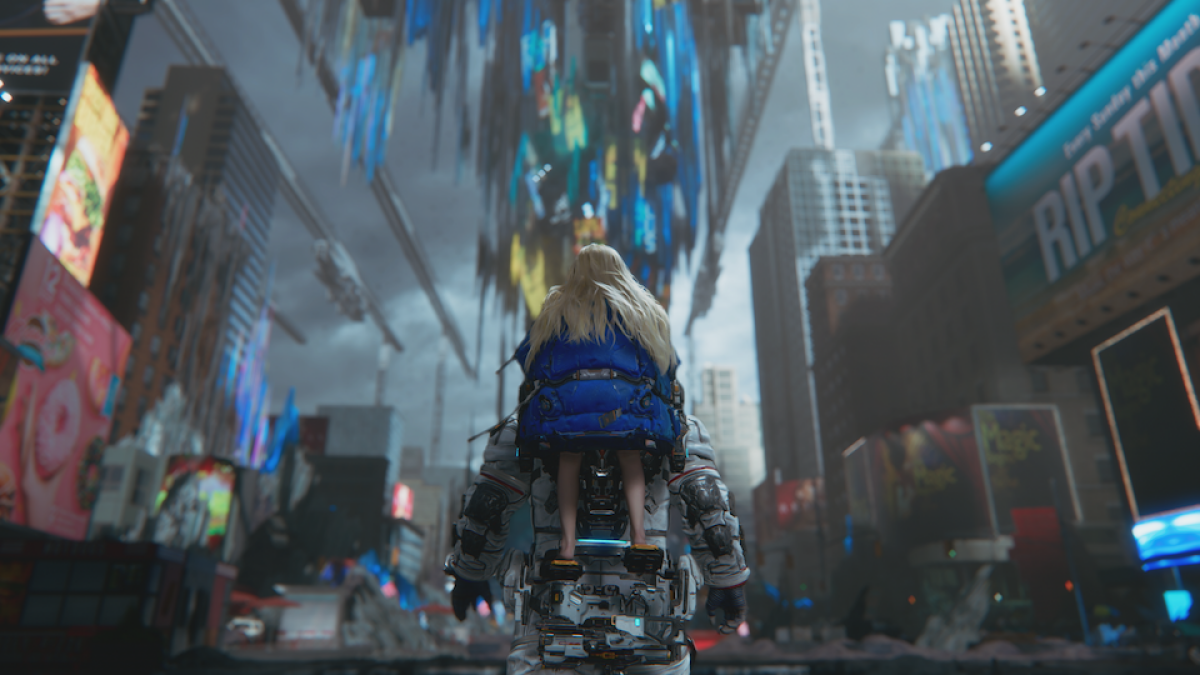
Taxis sink halfway into asphalt, whilst buses jut horizontally from tenement walls; all while billboards loop advertisements for products that look like they exist, but clearly do not when attention is paid. This is Pragmata’s New York as rendered in Capcom’s latest title, and every single glitch was placed by the hand of a living, breathing, human artist.
Pragmata’s premise is straightforward enough: a hostile artificial intelligence (AI) has constructed a synthetic version of the city of New York from imperfect data, producing something recognisable; and yet persistently wrong. Director Cho Yonghee and producer Naoto Oyama, speaking to the Japanese outlet 4Gamer (translated by Automaton), described the creative challenge this posed during development: trained environment artists who have spent years – in some cases, decades – learning how to make a city block look real cannot easily produce one that looks ‘hallucinatorially‘ wrong.
During development, the team discovered how human aesthetic instincts actively resist producing purposeless visual noise. Then there was the issue of how when pushing the distortions too far, players began interpreting them as puzzle clues. Conversely, pulling them back too much meant the AI-generated conceit collapses into ordinary stylisation – defeating the entire point of the aesthetic. Perhaps the biggest issue was how the errors the artists produced kept looking too purposeful, composed, and over-authored – clearly hand-made versus being machine created. Genuine AI-generated imagery fails in ways lacking intentionality; which human artists, even when trying to replicate this failure, cannot help but impose structure upon.
Elie Gould of PC Gamer described the result as “human-made AI slop”, and the phrase captures both the aesthetic and its absurdity. Pragmata‘s New York is, by this measure, the most laboriously constructed piece of bad-on-purpose art direction in recent memory – and, in its own perverse way, serves as a quiet demonstration of how the visual hallmarks of generative AI are not a neutral default state anyone can reproduce by trying. As a matter of fact they are, when recreated by human hands, a style.

Pragmata was first revealed during Sony’s PlayStation 5 announcement event in June 2020. At that point, ChatGPT was over two years away from public release, Stable Diffusion did not yet exist, and the phrase “AI slop” had not yet entered the cultural lexicon. The artistic anxieties dominating creative industries today were largely confined to academic papers and machine learning conferences.
Cho has been direct about the timing. Speaking to PC Gamer, the director acknowledged how generative AI technology had not yet reached its current heights when the concept was first being developed. Rather than claiming prescience, Cho offered a more philosophical reading: “perhaps that shows how they’re eternal themes as well”. In the most basic of termsL the team did not predict this cultural moment, instead the moment caught up with them.
Worldbuilding for Pragmata was supervised by Shoji Kawamori, the original creator of the Macross franchise, which speaks to the seriousness of the science fiction underpinning the project. It is also Capcom’s first all-new worldwide intellectual property since Dragon’s Dogma in 2012; a 14-year gap during which the publisher has leaned heavily on existing franchises, making Pragmata a meaningful institutional bet.

Capcom has, in recent years, publicly committed to not implementing assets generated by AI into its game content, whilst still indicating how these unique tools may be used internally to enhance development efficiency. It would be a little too ‘on-the-nose’ to read Pragmata’s New York as a public expression of this policy – a corporate thesis rendered in game level geometry. Cho and Oyama have not referenced the game in this way; however, they have framed it as in-fiction worldbuilding for a story about a hostile machine intelligence. The connection to the broader debate is one observers are drawing after the fact.
Yet Cho and Oyama did not need to publicise the craft paradox at the centre of this project. They could have described New York as a creative challenge and left it there. Instead, they talked openly about the tension between human intentionality and machine randomness, discussing the difficulty of faking incompetence, and commenting on the careful calibration required to make something look accidentally wrong rather than deliberately so. This candour suggests the team understood they were producing something with implications beyond the game itself.
When reading between the lines, one can gleam how Pragmata’s New York is an inadvertent piece of evidence in a live cultural argument about the nature of creative labour. The team behind the game set out to make a setting that looked AI-generated and discovered, empirically, how this is truly difficult for trained humans to do. The errors kept looking too purposeful; and human aesthetic instincts could not simply be ‘switched off’. What this suggests – if one is inclined to draw conclusions from it – is how the visual hallmarks of generative AI are not a neutral default state of imagery, waiting to be accessed by anyone who tries. Rather, they are the absence of something human artists cannot so easily suppress. Intentionality, in other words, is not a stylistic choice, but a baseline inherent to human work. It also speaks to why, at least at present, AI generated content can still be spotted – even if the divide is closing rather rapidly.
The relative merits of human versus machine-generated art aside – a debate that will continue regardless of what a single Japanese development team discovered whilst building a lunar dystopia – one thing is clear: the visual language of artificial creativity is harder to imitate than it looks, and is perhaps the clearest indication yet of why human involvement in creative works may prove harder to replace than the current discourse assumes.

Owner, founder and editor-in-chief at Vamers, Hans has a vested interest in geek culture and the interactive entertainment industry. With a Masters degree in Communications and Ludology, he is well read and versed in matters relating to video games and communication media, among many other topics of interest.
- Hans Haupthttps://vamers.com/author/hanshaupt/

- Hans Haupthttps://vamers.com/author/hanshaupt/

- Hans Haupthttps://vamers.com/author/hanshaupt/

- Hans Haupthttps://vamers.com/author/hanshaupt/

- Hans Haupthttps://vamers.com/author/hanshaupt/

- Hans Haupthttps://vamers.com/author/hanshaupt/

- Hans Haupthttps://vamers.com/author/hanshaupt/

- Hans Haupthttps://vamers.com/author/hanshaupt/