
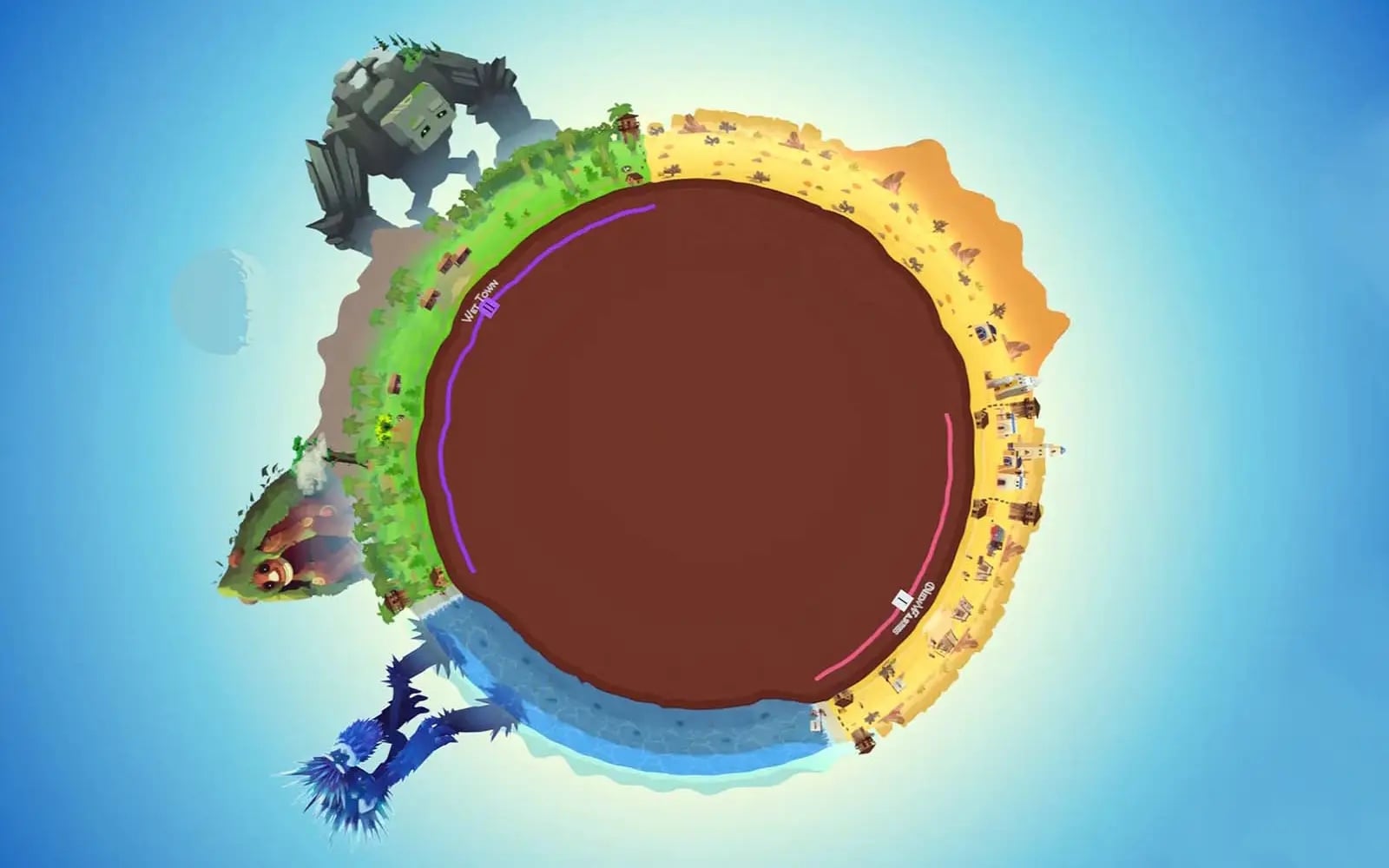
Reus 2 is a title that can be succinctly described as a strategic simulation about control through creation. Developed by Abbey Games, it places players in the role of a cosmic architect who must shape a living world from nothing but soil, water, and will. It is not about power for its own sake, nor is it a conventional city builder in the traditional sense. Rather, the game is an intricate exercise in ecological balance, where every action influences how humanity emerges and evolves upon the surface of the users own personal design.
At its foundation, Reus 2 expands upon the original concept with greater mechanical depth and a wider systemic reach. Each new world begins as an empty globe, ready to be sculpted by four elemental giants who serve as the conduits of your influence. Through them, you create biomes, plant forests, raise mountains, seed oceans, and distribute life in the form of flora, fauna, and minerals. These are collectively referred to as biotica, and they form the basis of every resource the human settlements require to prosper. The challenge lies not in the individual placement of each element, but in the relationships they form. Certain biotica thrive together, others compete, and many produce synergistic bonuses when arranged with care and precision.

The loop at the centre of Reus 2 is both meditative and analytical. It rewards players who approach it as an evolving puzzle rather than a sandbox of chaos. Each run presents a planet with different environmental conditions and challenges, yet the process of experimentation remains the same. You observe, adjust, and learn from the results. In time, players will begin to recognise patterns in biodiversity, resource flow, and settlement behaviour. There is a certain amount of satisfaction in finding the optimal arrangement allowing humanity to flourish through a carefully constructed ecosystem, versus direct control.
Where the first Reus offered modest scope, the sequel introduces a metaprogression system linking each planetary experiment to the next. Completing worlds unlocks new biotica, new giants, and additional modifiers expanding the strategic potential. This structure ensures every session contributes to long-term growth, transforming what might have been a static simulation into a layered progression model. It also alleviates the fatigue often accompanying similar games, where early mistakes can render later decisions meaningless. In Reus 2, each attempt teaches something of value.

Visually, the game retains the stylised charm of its predecessor, yet the presentation has been notably refined. The interface is clean, the animation smooth, and the world itself vibrant with minimal distraction. The music complements the tone perfectly, reinforcing the sense of calm focus defining the experience. It is the sort of game best played at an unhurried pace, where one can appreciate the subtle shifts of colour and rhythm as a world matures under one’s careful supervision.
There are, however, elements tempering the overall experience. The early game can feel restrictive, particularly before the more advanced biotica and giants are unlocked. Some systems also lack immediate clarity, and the in-game explanations occasionally assume a level of familiarity that some newcomers may not yet possess. There are also certain issues with controller navigation when played on console, which can prove to be rather cumbersome and frustrating over long gaming sessions. Additionally, those who expect a true sandbox, where experimentation can lead to unpredictable or chaotic outcomes, may find the design a little bit too structured. However, Reus 2 is deliberate in its construction, and while that structure lends coherence, it also limits a certain level of spontaneity.

Despite these reservations, Abbey Games has produced a sequel of considerable merit. Reus 2 is a complex, intelligent, and unusually reflective strategy title, one inviting players to think in systems rather than impulses. It rewards precision, patience, and curiosity despite being slow to reveal its full depth. Gamers who stick with the title, however, will eventually gain a deeply satisfying understanding of its interwoven mechanics.
In the end, Reus 2 stands as a thoughtful reimagining of the god-game genre. It does not rely on spectacle or narrative drama, focussing instead on the quiet joy of mastery. For players who enjoy strategy distilled into pure design logic, it is a compelling proposition. The depth of its simulation, combined with its understated presentation, make it both an engaging and oddly calming experience. Reus 2 rewards time, reflection, and a willingness to learn how every element connects to the whole.
Verdict:
GOOD [4/5]
| PROS | CONS |
| Deep systemic design where biotica interactions and biodiversity mechanics reward careful optimisation | Early progression can feel limited before key giants and biotica are unlocked |
| Meaningful meta-progression expanding strategic possibilities | Certain mechanics lack immediate clarity, requiring experimentation before their full value becomes apparent |
| Polished visual presentation and restrained audio design complements pace of play | Using a controller can be incredibly frustrating |
Title reviewed on Xbox Series X with code supplied by publisher.
Review Methodology | Ethics Policy

Owner, founder and editor-in-chief at Vamers, Hans has a vested interest in geek culture and the interactive entertainment industry. With a Masters degree in Communications and Ludology, he is well read and versed in matters relating to video games and communication media, among many other topics of interest.
- Hans Haupthttps://vamers.com/author/hanshaupt/

- Hans Haupthttps://vamers.com/author/hanshaupt/

- Hans Haupthttps://vamers.com/author/hanshaupt/

- Hans Haupthttps://vamers.com/author/hanshaupt/

- Hans Haupthttps://vamers.com/author/hanshaupt/

- Hans Haupthttps://vamers.com/author/hanshaupt/
- Hans Haupthttps://vamers.com/author/hanshaupt/

- Hans Haupthttps://vamers.com/author/hanshaupt/