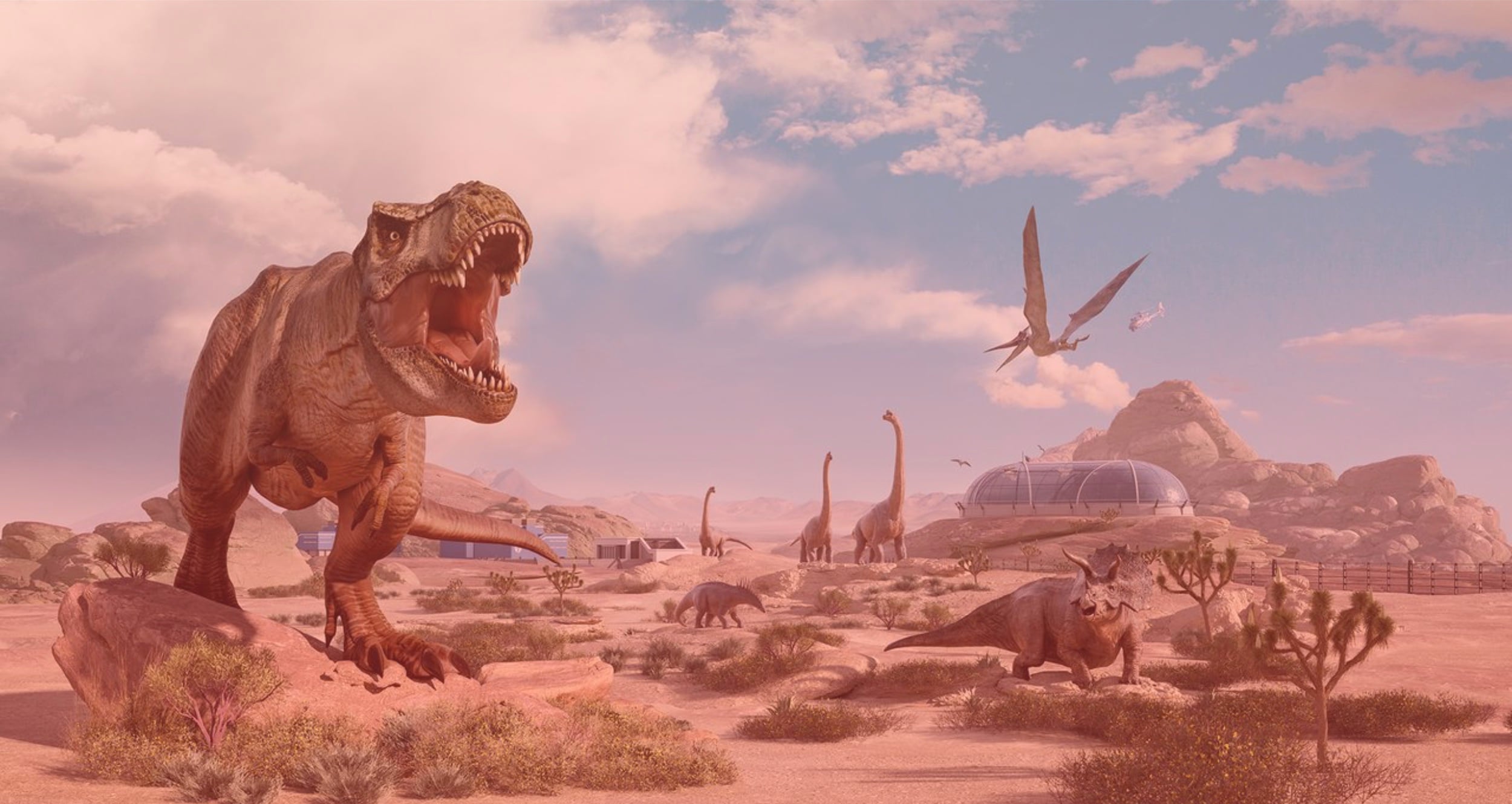
When I reviewed Jurassic World Evolution in 2018, I found an alluring concept dressed to impress, with show-stopping prehistoric stars and a handful of systems that sang in frustrating harmony. Three years later and Jurassic World Evolution 2 enters the fray as the game I feel Frontier really wanted to make all along. In this sense, the sequel is not merely another reboot of the park fantasy, but rather a careful refit where the scaffolding is stronger, the spectacle richer, and the day-to-day rhythm of management is finally confident enough to encourage play that flows more than it creaks. Playing on console underscores this point, with an enhanced almost controller-first experience spearheading a management game that seemingly understands the living room context, all whilst giving enough friction to make a flourishing park feel earned. The park is once again open, and absolutely for the better.
Set after the events of Jurassic World Fallen Kingdom (2018), the campaign repositions you as a kind of ‘conservation manager’ working alongside familiar voices to stabilise ecosystems that have already been broken open by human hubris. The structure is brisk and purposeful, offering a guided sequence introducing core tools that then need to be applied under mild pressure. The introduction and core aspect of the main campaign does not overstay its welcome, nor does it attempt grand narrative beats. Instead, it functions as a brief onboarding where the new pillars of gameplay are immediately felt: enclosures no longer end at the fence line; aviaries claim the sky, lagoons open the water; territory and comfort blend through more convincing behaviour routines; and staff now matter in a way that nudges decisions beyond simple budget shuffling. In practice, it turns what began as a sightseeing tour in the first game into a working reserve you can believe in. Even so, and somewhat disappointingly, the campaign remains a mere stepping stone in the full experience – at least at first.
If there is a place where Jurassic World Evolution 2‘s restraint turns conservative, it is the campaign. Despite serving well as an introduction, the story is very much a ‘blink and you are done’ type of endeavour. The structure refuses melodrama and rarely forces hard choices under duress, which keeps frustration low, but also ensures the most interesting stories happen outside the story mode. Interestingly, I do not consider this a fatal flaw of the title. Jurassic World Evolution 2 is most alive in spaces where authorship belongs to the player rather than the script, and the campaign’s limited scope keeps the field clear for what follows. Still, I would have welcomed an extra turn of the screw before the outro, if only to earn the game’s later swagger. With that said, the real drama, the kind of scenario building that lingers long after it is complete, lives in Dr Ian Malcolm’s speciality: Chaos Theory.
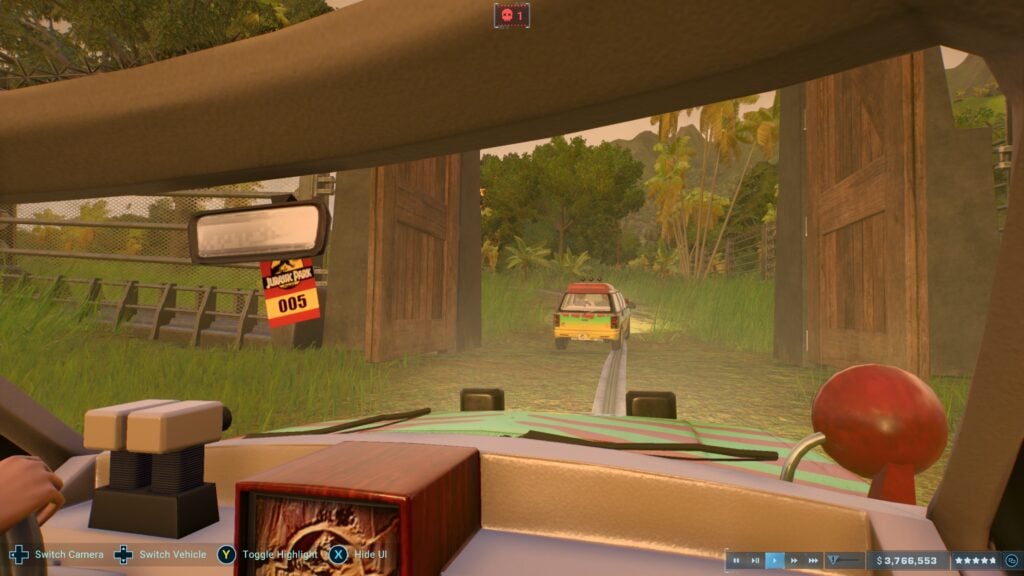
Enhanced from the original title, the ‘Chaos Theory’ mode is a set of “what if” scenarios drawing from the films without feeling like a museum exhibit. In many respects, each of the scenarios behave like ‘mini-campaigns’; and it breathes a wonderful freshness into the title. It also allows us to be a little more forgiving of the short ‘campaign’. Nevertheless, this is where the game’s incredible simulation reveals its timing. From inclement weather colliding with infrastructure, through to the carefully arranged flow of guests, viewing galleries, and operations unpicked by a sudden squall or a patient carnivore testing perimeter integrity – all while you are preoccupied with an ailing hadrosaur and a medical team one zone too far away – it ensures you are kept on your toes. Ultimately, Chaos Theory excels beyond expectation, because it respects the park manager fantasy. It does not drown you in spreadsheets, nor does it shrug off consequence. Rather, each unique scenario is designed like cinematic theatre for emergent mishaps, with a monetary score ticking up in the corner as you hold the line as best as you can. I kept returning to these scenarios long after the credits rolled on the campaign, not because I had to, but because the spaces they offer are generous and surprising enough to invite tinkering. They can also be incredibly difficult at higher levels, providing enough of a challenge with a side of “just one more time”.
Once Chaos Theory has helped internalise all of the new gameplay rhythms on offer, Sandbox mode becomes the comfortable new home for experienced players. By this point the game assumes you know what sort of park you want to build. You may start with the quiet satisfaction of a herbivore sanctuary arranged around gentle viewing angles and walkways, then decide you would prefer to carve a lagoon through the dust and drop a marine apex predator into the middle of it. Sandbox supports these impulses with fewer tantrums than the first game, since placement tools and terrain brushes have been softened to allow more forgiveness. However, the game still asks for intent and you cannot simply spam attractions and hope for the best. Unlike the first title, guests now carry specific preferences that shape districts, and a park that disregards them will look full and feel hollow.
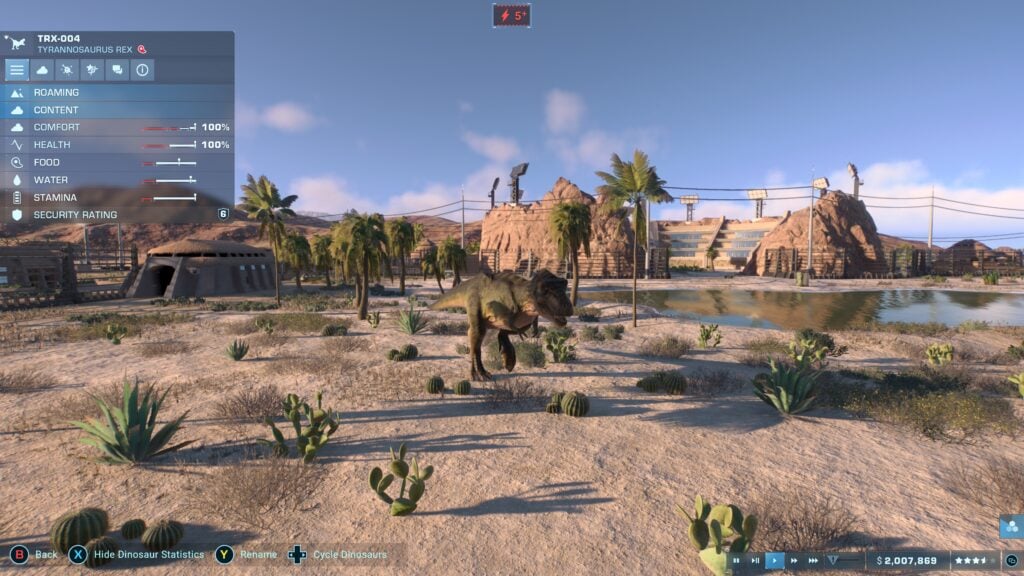
Of course, the enhanced gameplay loops and engaging new scenarios to revisit would be nowhere near as fun as they are if it was not for the all new headline additions: aviaries for flying reptiles and lagoons for marine life. These highly requested features change both sight-lines and guest flow, whilst also altering how one thinks about the overall harmony of the park being built. An aviary might push you to consider verticality, whereas a lagoon could reframe the park around a sea of attention. Once you begin to braid land, air, and water, something subtle happens: the dinosaurs stop feeling like units placed in boxes, and start reading like occupants, using these hand crafted spaces in ways you must meet with design rather than brute force. Fences still break, of course, and tranquilliser darts still thud against scaly hides when a storm tests the grid, but the tone of these crises has shifted from unnatural chore to earned tension.
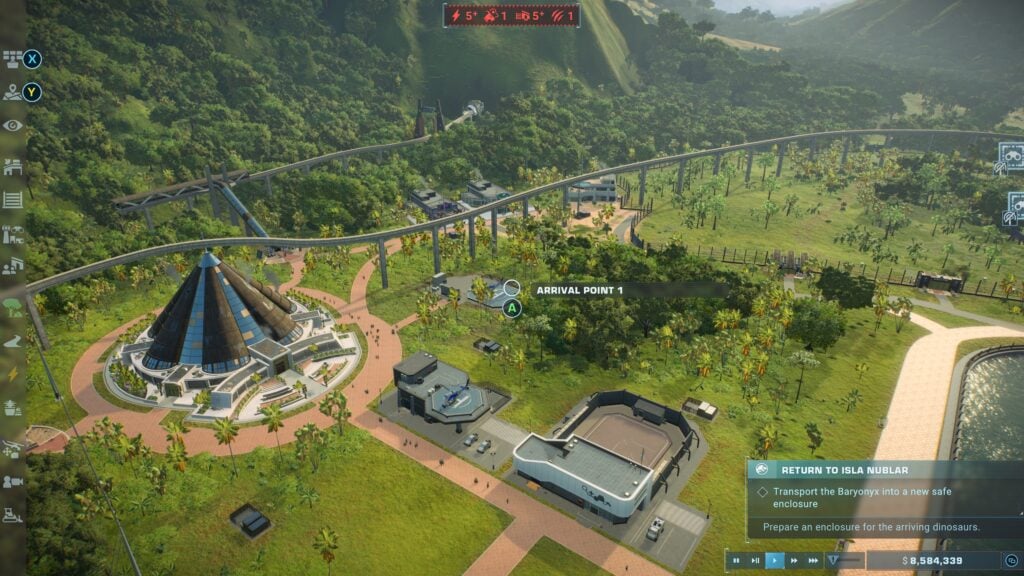
Much of this new found realism is possible because the territory and comfort needs of the dinosaurs finally behave in a way that makes intuitive sense. Give these magnificent animals enough space, de-clutter enclosures, balance food and water, and you will notice aggression drops along with escape attempts. Mix species carelessly and the park becomes a sequence of apologies, but do it wisely and the visual rhythm of grazing, resting, and roaming becomes engrossingly beautiful. There is still an element of number watching, which any management game struggling to balance simulation with legibility must accept, yet Jurassic World Evolution 2 layers those numbers into animations and sound design with such assurance that it seldom, if ever, feels clinical.
The palaeo-medical layer of gameplay in Jurassic World Evolution 2 carries more weight now too, and although it can veer towards busywork when a park sprawls, it succeeds in giving caretaking its own tempo. Diagnostics, treatment, and the leisurely ballet of helicopters, jeeps, and status checks provides welcome pockets of focused action. There is great satisfaction in tracing a complaint to its root cause; sometimes a nutritional gap, an infection seeded by weather or crowding, or perhaps a design flaw you must admit and rectify. Scientists are no longer abstract icons either as they now anchor research speed, expedition throughput, and medical competence; all of which gently encourages a staffing strategy rather than a tick-box exercise. Push them too hard and friction arises in interesting ways. Treat them well and the park hums whilst profits grow.
Late game also exposes seams familiar to anyone who has ever loved a sim’s promise more than its limits. Parkwide micromanagement can escalate into a whack-a-mole rhythm during sustained weather events; one enclosure loses power at the precise moment another registers a comfort drop, and as you handle those plates, a third decides to make a break for it. The dance can amuse for a while, yet the higher your ambitions the more you may feel the user interface (UI) itself is a scarce resource, as if inputs could bottleneck organisational thought. It is a small frustration, more a natural consequence of ambition on a controller than a design failure, and it is easily soothed by systems which, for the most part, respect the time you are willing to give.
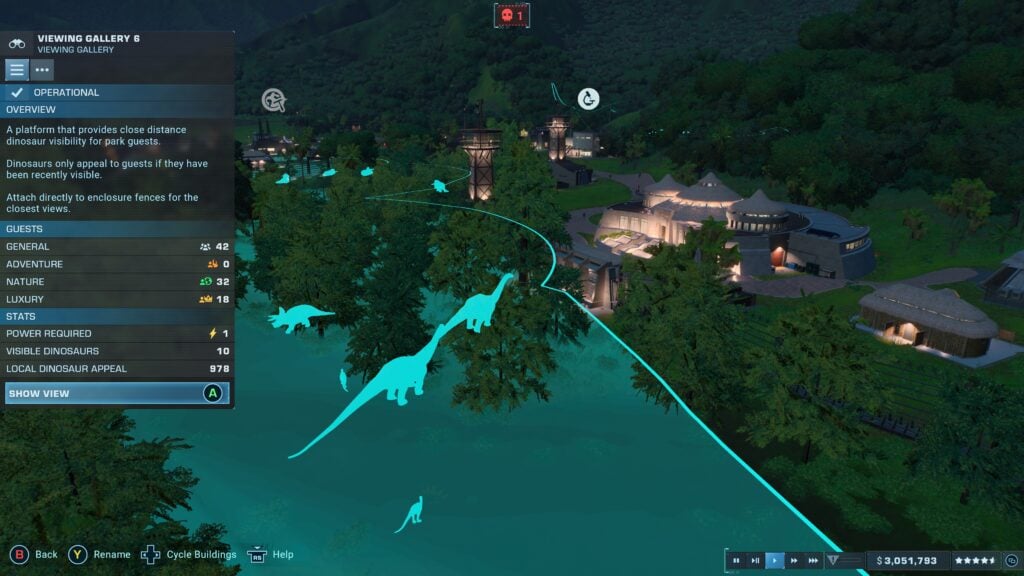
What matters is how the game feels overall. How it sits in the hands in the evenings where forty-five minutes become two hours because you were certain a tweak to path layout would unlock a cascade of guest satisfaction that frees enough budget for the lagoon you have been sketching in your mind. This is where Jurassic World Evolution 2 finds its centre. The sequel understands spectacle is nothing without systems that can carry it, and systems are nothing without a surface that invites play. On console, that surface is smooth. The spectral memory of the first game’s stiffness melts away once you have built your first successful tri-biome park and ridden a jeep along the fence at night, light spilling through the tree tops as a storm line splits the sky and you realise you built this place, and for the next sixty seconds everything works exactly as you imagined.
Where the first game often felt a little stubborn under a controller, this sequel has been finely tuned to almost feel ‘controller’ first. Radial menus, snapping, and smart cursors allow for quick iteration without the fat-fingered dread of misplacing a building by an inch and discovering the pathing will never forgive the oversight. Vehicles feel more like extensions of the camera than awkward toys, so when you decide to personally drive a ranger team through a storm to deliver a last-minute resupply, it feels performative in the best sense – the jeeps still have ridiculous bounce physics though. The interface grows dense as parks mature and overlays multiply, yet the cadence of switching views and scanning problems becomes second nature if you settle into it. I found myself making changes while barely thinking about the inputs, which is the highest praise I can offer any living room management interface.
Interestingly, performance on current-gen consoles appears to lean towards consistency rather than bravado. Frame pacing favours a clean image with steady motion over headline numbers, something I appreciate in a genre where clarity is king and moment-to-moment readability often matters more than raw output. Lighting does heavy lifting at dusk, where skin shaders and foliage breathe, and water surfaces do not merely reflect but ripple with intent. Crowds remain functional rather than fussy, which suits the staging given how the game wishes for you to focus attention on the animals and the machines that serve them, not on photorealistic popcorn in a guest’s hand. Sound design ties the picture together astoundingly well, with audio being one of the highlights of Jurassic World Evolution 2. Bone, breath, wind, and weather carry across the park in a way that grounds the whole assemblage, with the score stepping forward in crescendos during moments of pressure and receding into a warm undertone when order returns.
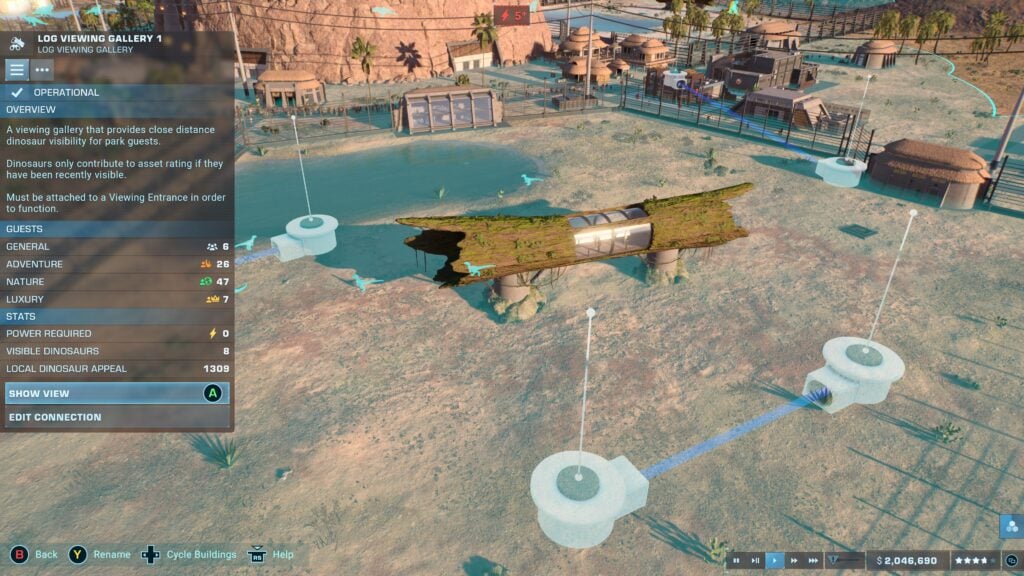
For readers who want an explicit discussion of depth, this is not a hardcore management simulator hiding behind a blockbuster licence; and it never pretends to be. Depth comes from composition rather than raw complexity. The way territory, temperament, and guest profiling interlock creates a puzzle you solve through layout, pacing, and restraint. It asks you to decide what kind of park you want, then rewards commitment to that identity. I do continue to wish for a slightly fiercer economic model, a few extra risks baked into staffing, and a late-game escalation where the simulation steps forward another bit more, yet I cannot deny how well the current balance serves the intended audience.
It goes without saying how it is almost impossible to talk about a Jurassic Park game without mentioning presence. In this respect the sequel delivers. Animal animation and sound carry enough nuance to dodge uncanny stiffness; the weight of motion persuades the eye, whereas the chorus of roars and hisses soothes the ear. The world beyond enclosures does not demand close inspection because it does not need to. Vegetation frames scenes rather than insists on itself. Buildings provide legibility rather than architectural indulgence. Every now and then the light knifes through dust at sunset and you are reminded why the films worked at all. The magic was never realism; it was the conviction to hold a shot long enough for a feeling to settle. Jurassic World Evolution 2 understands this priority, and lives in it with aplomb.
If you asked me where the sequel stands in relation to its predecessor, I would say it feels decisive rather than defensive. The first game wore its licence heavily, always a little afraid to disappoint, often shy about asking players to own their mistakes. The second trusts you with more moving parts and is consequently less embarrassed when they collide. By the time the parks reach maturity, your role feels less like a caretaker chasing notifications and more like an organiser of attention, someone who sets a theme and executes it. Needless to say, this is a fairly meaningful shift.
Jurassic World Evolution 2 is a confident piece of work that respects your time, showcases its stars without apology, and offers enough systemic bite to keep the fantasy honest. There are still familiar aches, such as a campaign that bows early, occasional interface clutter under stress, and a late-game loop that could climb higher. Yet the balance is wise, the feel is right, and the result is a dinosaur park builder I kept playing long after I had enough notes to write this piece.
Verdict:
EXCEPTIONAL
| PROS | CONS |
Chaos Theory scenarios deliver cinematic, replayable “what if” park stories. | Campaign functions more as an extended tutorial than a full narrative. |
Sandbox and Challenge modes offer flexibility and longevity. | Management depth remains lighter than hardcore simulation titles. |
Stronger behavioural systems: territory, comfort, and social dynamics feel convincing. | Some interactions and guest crowds feel functional rather than detailed. |
Gorgeous lighting, skin shaders, and atmospheric audio design. |
Title reviewed on Xbox Series X with code supplied by publisher.
Review Methodology | Ethics Policy

Owner, founder and editor-in-chief at Vamers, Hans has a vested interest in geek culture and the interactive entertainment industry. With a Masters degree in Communications and Ludology, he is well read and versed in matters relating to video games and communication media, among many other topics of interest.
- Hans Haupthttps://vamers.com/author/hanshaupt/

- Hans Haupthttps://vamers.com/author/hanshaupt/

- Hans Haupthttps://vamers.com/author/hanshaupt/

- Hans Haupthttps://vamers.com/author/hanshaupt/

- Hans Haupthttps://vamers.com/author/hanshaupt/

- Hans Haupthttps://vamers.com/author/hanshaupt/
- Hans Haupthttps://vamers.com/author/hanshaupt/

- Hans Haupthttps://vamers.com/author/hanshaupt/